Books
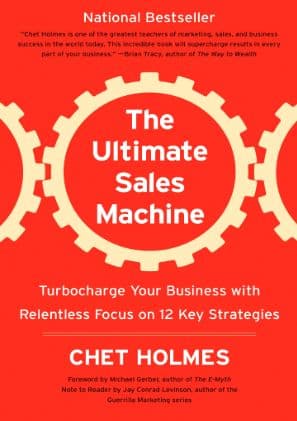
The Ultimate Sales Machine by Chet Holmes
The Ultimate Sales Machine presents Chet Holmes’s systematic approach to building a stronger business by mastering a small number of essential disciplines rather than constantly chasing new strategies. Covering sales, marketing, management, training, prospecting, and strategic focus, the book shows how consistent execution and what Holmes calls “pigheaded discipline and determination” can transform ordinary business processes into a powerful growth system.
📖 Overview
Most businesses don't suffer from a lack of ideas.
They suffer from a lack of consistent execution.
That principle sits at the heart of Chet Holmes's The Ultimate Sales Machine.
Instead of encouraging business owners to continuously adopt new tactics, Holmes argues that extraordinary organizations become exceptional by identifying a handful of critical activities and practicing them repeatedly until they become excellent at them.
The book organizes this philosophy into twelve core strategies covering areas such as time management, employee training, marketing, sales, prospecting, presentations, and customer acquisition.
Its central message is simple:
Master a few fundamentals relentlessly instead of doing hundreds of things inconsistently.
🎯 Why This Book Is Worth Reading
Modern business advice constantly introduces something new.
A new marketing channel.
A new sales technique.
A new productivity system.
A new growth strategy.
The temptation is to keep switching from one method to another.
Holmes argues for almost the opposite approach.
Improvement comes from repeatedly strengthening the fundamental systems responsible for generating customers and delivering results.
This makes The Ultimate Sales Machine particularly useful because it doesn't treat sales, marketing, management, and productivity as completely separate disciplines.
It shows how they work together as parts of one business machine.
👥 Who Should Read This Book
- Entrepreneurs
- Sales professionals
- Sales managers
- Business owners
- Marketing professionals
- Startup founders
- Business development teams
- Leaders responsible for organizational growth
🧠 Key Concepts
- Pigheaded Discipline and Determination
- Sales Systems
- Strategic Focus
- Time Management
- Employee Training
- High-Value Prospecting
- The Dream 100
- Educational Marketing
- Sales Presentations
- Follow-Up
- Customer Acquisition
- Continuous Improvement
💡 In-Depth Discussion
1. Mastery Comes From Repetition
Holmes argues that companies frequently spread their attention across too many initiatives.
The result is shallow execution.
Instead, he recommends identifying the activities that produce the greatest results and becoming exceptionally good at them.
The principle resembles deliberate practice:
Choose the fundamentals → Practice them repeatedly → Measure performance → Improve → Repeat.
Knowing a strategy isn't enough.
The competitive advantage comes from executing it better than everyone else.
2. Pigheaded Discipline and Determination
One of Holmes's most memorable concepts is what he calls pigheaded discipline and determination.
Business improvement rarely comes from discovering one revolutionary idea.
More often, it comes from executing ordinary but important activities consistently.
Training employees once isn't enough.
Prospecting occasionally isn't enough.
Following up whenever you remember isn't enough.
Processes need repetition.
Holmes therefore shifts the question from:
“What new strategy should we try?”
to:
“Which proven strategy should we execute better?”
3. The Dream 100 Strategy
Perhaps the book's best-known idea is the Dream 100.
Instead of attempting to market equally to thousands of potential customers, identify a smaller group of high-value prospects whose business could significantly affect your company.
Then pursue those prospects systematically.
The exact number doesn't necessarily need to be 100.
The underlying principle is concentration.
A small number of ideal customers may represent more potential value than a large number of poorly matched prospects.
Rather than asking:
“How do we reach everyone?”
ask:
“Who would make the biggest difference if they became our customer?”
4. Educate Before You Sell
Holmes advocates using education as part of marketing and selling.
Instead of immediately presenting your product, teach prospects something useful about their market, problems, opportunities, or changing environment.
This changes the relationship.
Traditional selling often begins with:
“Here's what we sell.”
Educational selling begins with:
“Here's something important you should understand.”
The product can then appear naturally as part of the solution.
Done properly, this approach builds credibility before asking for a purchase.
5. Build a Sales Process
Great salespeople can produce impressive results individually.
But businesses become more scalable when good selling becomes a repeatable process.
That means defining and improving each stage:
Prospecting → Qualification → Presentation → Objection Handling → Closing → Follow-Up
When the process is documented, companies can train new salespeople more effectively and identify where opportunities are being lost.
Sales becomes less dependent on individual improvisation and more dependent on a system.
6. Training Should Never Stop
Holmes treats training as an ongoing business activity rather than something employees receive only when they join.
Why?
Because knowing something once doesn't guarantee consistent execution.
Salespeople need practice.
Managers need practice.
Presentations need refinement.
Objection handling needs rehearsal.
Repeated training converts knowledge into behavior.
And repeated behavior eventually becomes organizational capability.
🛠 How to Apply the Ideas
Start by creating your own Dream 100.
Identify the highest-value prospects in your market.
For each one, record:
Prospect → Why they fit → Decision maker → Main problem → Potential value → Current relationship → Next action
Then create a consistent outreach system.
Instead of contacting them once and abandoning the opportunity, develop useful reasons to remain visible.
You might share relevant research, educational content, insights, case studies, or solutions to problems they care about.
The objective isn't to spam 100 companies.
It's to build meaningful familiarity with a carefully selected group of valuable prospects.
🌟 IslandHub Insight
Perhaps the most valuable idea in The Ultimate Sales Machine isn't a particular sales tactic.
It's the philosophy behind the entire book:
You probably don't need another strategy. You need to execute your best strategies better.
Businesses often confuse novelty with progress.
A new tool feels productive.
A new marketing channel feels exciting.
A new sales technique feels promising.
But constantly changing systems prevents organizations from becoming exceptional at any of them.
The better approach may be surprisingly boring:
Choose what matters.
Create a process.
Measure it.
Practice it.
Improve it.
Then repeat it long enough for compounding to happen.
That's how a collection of ordinary business activities can gradually become an ultimate sales machine.
📚 Related Books
- SPIN Selling — Neil Rackham
- To Sell Is Human — Daniel H. Pink
- Influence — Robert B. Cialdini
- Sell or Be Sold — Grant Cardone
- The E-Myth Revisited — Michael E. Gerber
❓ Questions to Reflect On
- Which three activities currently generate most of your business results?
- Who would belong on your own Dream 100 list?
- Are you constantly searching for new strategies instead of mastering the ones you already know?
📖 References
- Holmes, C. The Ultimate Sales Machine.
- Rackham, N. SPIN Selling.
- Cialdini, R. B. Influence.
- Pink, D. H. To Sell Is Human.
- Gerber, M. E. The E-Myth Revisited.
Continue Learning
Deepen your understanding with related content

Ekonomi Indonesia 2026: Mengapa Rupiah "Tumbang" Saat Pertumbuhan Tetap Solid?
Noah Walker

Rahasia Metabolisme: Mengapa Gaya Hidup Modern Diam-Diam Menghambat Tujuan Sehat Anda?
Noah Walker

Paradoks Listrik 2026: Antara Jebakan Inflasi 4,76% dan Ambisi Kedaulatan Energi di Selat Hormuz
Noah Walker

Subsidi BBM 2026: Beban Rp210T di APBN demi Harga BBM Stabil
Noah Walker
Apply What You Learned
Try these tools to put your knowledge into practice
Explore Similar
Readers also explored these resources
The New Strategic Selling by Robert B. Miller
Noah Walker
Solution Selling : Creating Buyers in Difficult Selling Markets by Bosworth, Michael T
Books
Selling To Big Companies by Jill Konrath
Noah Walker
The Spin Selling Fieldbook: Practical Tools, Methods, Exercises And Resources by Neil Rackham
Noah Walker
Sell Or Be Sold by Grant Cardone
Noah Walker
The Psychology of Selling by Brian Tracy
Noah Walker
Continue Exploring IslandHub
Discover more from across the platform