Books
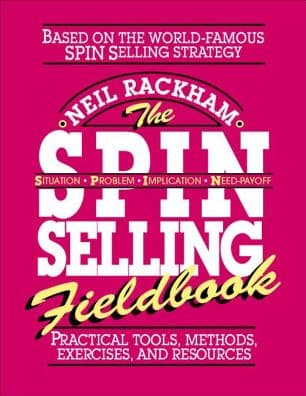
The Spin Selling Fieldbook: Practical Tools, Methods, Exercises And Resources by Neil Rackham
The SPIN Selling Fieldbook transforms Neil Rackham’s research-based SPIN Selling methodology into a practical system for improving complex sales conversations. Through exercises, diagnostic tools, planning frameworks, and real-world applications, the book teaches salespeople how to uncover customer needs using Situation, Problem, Implication, and Need-payoff questions. Rather than relying on aggressive persuasion or traditional closing techniques, it focuses on helping customers recognize the significance and value of solving their own problems.
📖 Overview
Great selling isn't necessarily about having the perfect pitch.
Sometimes, it's about asking the right questions.
The SPIN Selling Fieldbook is Neil Rackham's practical companion to his influential SPIN Selling methodology.
Based on extensive research into real sales conversations, the SPIN framework organizes effective questioning into four categories:
Situation → Problem → Implication → Need-payoff
Rather than immediately presenting a solution, salespeople learn to understand the customer's situation, uncover meaningful problems, explore their consequences, and help customers recognize the value of solving them.
The fieldbook turns these principles into exercises, diagnostic tools, planning techniques, and practical activities that salespeople can use to improve their own conversations.
🎯 Why This Book Is Worth Reading
Many traditional sales techniques emphasize:
Pitching.
Persuading.
Overcoming objections.
Closing.
Rackham's research suggested that complex sales often require a different approach.
When the purchase is expensive, risky, or involves multiple decision-makers, customers usually need more than a persuasive presentation.
They need to understand why change is necessary.
That's where SPIN becomes useful.
Instead of immediately saying:
“Here's why our solution is great.”
SPIN helps you guide the customer toward answering:
“Why does this problem matter enough for us to solve it?”
That makes the methodology especially valuable for B2B, consulting, enterprise, and other high-value sales environments.
👥 Who Should Read This Book
- Sales professionals
- B2B sales teams
- Account executives
- Sales managers
- Consultants
- Business development professionals
- Entrepreneurs selling high-value solutions
- Anyone learning consultative selling
🧠 Key Concepts
- SPIN Selling
- Situation Questions
- Problem Questions
- Implication Questions
- Need-payoff Questions
- Explicit Needs
- Implied Needs
- Consultative Selling
- Value Discovery
- Sales Planning
- Questioning Skills
- Complex Sales
💡 In-Depth Discussion
1. Situation Questions
The first stage is understanding the customer's current situation.
These questions gather relevant facts and context.
For example:
“How are you currently managing customer inquiries?”
or:
“How many people are involved in this process?”
Situation questions provide useful information, but Rackham warns against asking too many.
Why?
Because the salesperson benefits from the information while the customer receives relatively little value from answering.
Good preparation therefore reduces unnecessary situation questions.
2. Problem Questions
Once you understand the situation, you begin exploring difficulties.
For example:
“Does that process ever create delays?”
or:
“Is it difficult to keep information consistent across those systems?”
Problem questions uncover dissatisfaction.
They move the conversation away from neutral facts and toward areas where improvement may be valuable.
This is where potential sales opportunities begin to emerge.
3. Implication Questions
Finding a problem isn't enough.
The customer must understand its consequences.
Suppose a customer says:
“Yes, our reporting process takes too long.”
A salesperson might immediately present automation software.
SPIN encourages another step.
Ask about the implications.
“How does that delay affect your team's ability to make decisions?”
Perhaps the original problem costs several hours.
But its consequences might include slower decisions, missed opportunities, higher labor costs, or dissatisfied customers.
The perceived importance of the problem grows as its consequences become clearer.
4. Need-Payoff Questions
Need-payoff questions shift attention from the problem toward the value of solving it.
For example:
“If reports could be generated automatically, how would that help your team?”
Notice what happens.
The salesperson isn't explaining the benefit.
The customer is describing the benefit.
That distinction is powerful.
Instead of saying:
“Our software will save you time.”
the customer might say:
“That would save our team ten hours every week.”
The value is now expressed in the customer's own language.
5. Implied Needs vs. Explicit Needs
Rackham distinguishes between two types of needs.
An implied need describes a problem:
“Our system is difficult to use.”
An explicit need expresses a desire for change:
“We need a simpler system that our entire team can use.”
This distinction becomes particularly important in larger sales.
Finding dissatisfaction isn't necessarily enough.
The salesperson needs to help the customer develop that dissatisfaction into a clear desire for a solution.
SPIN questions help facilitate that transition.
6. Don't Rush Into the Pitch
One of the easiest mistakes in selling happens when the salesperson discovers a problem that matches their product.
Customer:
“We're struggling with follow-up.”
Salesperson:
“Perfect! Our CRM automatically—”
Too early.
The salesperson understands the connection because they know the product.
The customer may not yet understand why solving the problem deserves attention.
SPIN encourages sellers to explore the problem before presenting the solution.
The sequence becomes:
Discover → Develop → Understand → Solve
rather than:
Discover → Pitch
🛠 How to Apply the Ideas
Before your next sales conversation, prepare a simple SPIN Question Map.
For example:
Situation
“How does your team currently generate leads?”
Problem
“Do you find it difficult to consistently follow up with every lead?”
Implication
“What happens when potential customers don't receive follow-up quickly?”
Need-payoff
“If your team could automate part of that process, what difference would it make?”
Don't treat these questions as a rigid script.
Use them as a framework for understanding the customer's world.
The objective isn't to ask every question you've prepared.
It's to discover which problems genuinely matter.
🌟 IslandHub Insight
The deeper lesson behind SPIN Selling is surprisingly simple:
The customer should do more of the discovering than the salesperson does of the convincing.
Weak selling often looks like this:
Product → Features → Benefits → Pressure → Close
SPIN changes the sequence:
Context → Problem → Consequence → Value → Solution
That shift matters because people rarely buy simply because a salesperson explains something well.
They buy when the value of solving a problem becomes greater than the cost, effort, or risk of changing.
Your job isn't merely to explain why your solution is valuable.
Your job is to help customers clearly understand:
Where they are.
What's preventing them from getting where they want to go.
Why that problem matters.
What changes if they solve it.
Once those answers become clear, the sale often becomes much easier.
📚 Related Books
- SPIN Selling — Neil Rackham
- The Challenger Sale — Matthew Dixon & Brent Adamson
- The Ultimate Sales Machine — Chet Holmes
- To Sell Is Human — Daniel H. Pink
- Influence — Robert B. Cialdini
❓ Questions to Reflect On
- Do your sales conversations contain more pitching or more meaningful questions?
- Which customer problems have you identified but failed to explore deeply enough?
- How could you help prospects articulate the value of your solution in their own words?
📖 References
- Rackham, N. The SPIN Selling Fieldbook: Practical Tools, Methods, Exercises and Resources.
- Rackham, N. SPIN Selling.
- Dixon, M., & Adamson, B. The Challenger Sale.
- Holmes, C. The Ultimate Sales Machine.
- Cialdini, R. B. Influence.
Continue Learning
Deepen your understanding with related content

Ekonomi Indonesia 2026: Mengapa Rupiah "Tumbang" Saat Pertumbuhan Tetap Solid?
Noah Walker

Rahasia Metabolisme: Mengapa Gaya Hidup Modern Diam-Diam Menghambat Tujuan Sehat Anda?
Noah Walker

Paradoks Listrik 2026: Antara Jebakan Inflasi 4,76% dan Ambisi Kedaulatan Energi di Selat Hormuz
Noah Walker

Subsidi BBM 2026: Beban Rp210T di APBN demi Harga BBM Stabil
Noah Walker
Apply What You Learned
Try these tools to put your knowledge into practice
Explore Similar
Readers also explored these resources
Solution Selling : Creating Buyers in Difficult Selling Markets by Bosworth, Michael T
Books
The New Strategic Selling by Robert B. Miller
Noah Walker
Selling To Big Companies by Jill Konrath
Noah Walker
The Psychology of Selling by Brian Tracy
Noah Walker
The Ultimate Sales Machine by Chet Holmes
Noah Walker
Sell Or Be Sold by Grant Cardone
Noah Walker
Continue Exploring IslandHub
Discover more from across the platform