Books
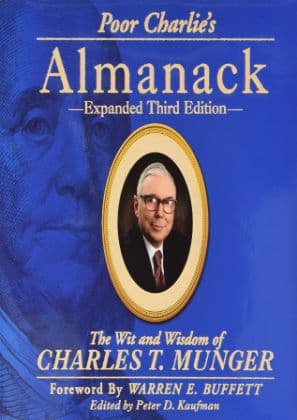
Poor Charlie's Almanack by Charles T. Munger
FeaturedMore than a book about investing, Poor Charlie's Almanack is a masterclass in clear thinking, decision-making, and lifelong learning. Through Charlie Munger's speeches and reflections, readers discover the mental models, psychological insights, and multidisciplinary approach that shaped one of the greatest investors in history.
📖 Overview
What separates exceptional decision-makers from everyone else?
According to Charlie Munger, it isn't intelligence alone—it's the ability to think across disciplines. Poor Charlie's Almanack is a collection of speeches, essays, and reflections from Charlie Munger, legendary investor and longtime vice chairman of Berkshire Hathaway. Compiled by Peter D. Kaufman, the book captures Munger's philosophy on investing, business, psychology, ethics, and lifelong learning.
Rather than presenting a formula for financial success, Munger argues that good decisions emerge from a broad understanding of how the world works. He encourages readers to build a "latticework of mental models" by studying multiple fields—including economics, mathematics, biology, psychology, engineering, and history—and applying them together instead of relying on narrow expertise.
The result is a timeless guide to rational thinking. Whether making investment decisions, leading a business, or navigating everyday life, Munger demonstrates that the quality of our outcomes depends largely on the quality of our thinking.
🎯 Why This Book Is Worth Reading
Many books teach readers what to think.
Poor Charlie's Almanack teaches readers how to think.
Charlie Munger challenges conventional wisdom by showing that complex problems rarely have simple solutions. Instead of searching for shortcuts, he advocates developing intellectual curiosity, recognizing cognitive biases, and making decisions based on fundamental principles rather than emotion.
The lessons extend far beyond investing. Entrepreneurs, students, scientists, executives, and lifelong learners will find practical insights that improve reasoning, judgment, and decision-making across every aspect of life.
👥 Who Should Read This Book
- Investors and value investing enthusiasts
- Entrepreneurs and business leaders
- Students across any discipline
- Professionals making complex decisions
- Managers and executives
- Researchers and academics
- Anyone interested in psychology and human behavior
- Lifelong learners seeking better judgment
🧠 Key Concepts
- Mental Models
- Multidisciplinary Thinking
- Cognitive Biases
- Rational Decision-Making
- Circle of Competence
- Incentives
- Opportunity Cost
- Inversion
- Lifelong Learning
- Compounding Knowledge
💡 In-Depth Discussion
1. Build a Latticework of Mental Models
Munger's most influential idea is that no single discipline can adequately explain the world.
Instead, effective thinkers combine concepts from multiple fields to create a mental framework—or latticework—that helps them solve complex problems more accurately. The broader your understanding, the better your decisions become.
2. Understand How the Mind Can Mislead You
Human beings are not naturally rational.
Munger explores dozens of psychological tendencies that distort judgment, including confirmation bias, social proof, overconfidence, and incentive-driven bias. Recognizing these patterns is the first step toward avoiding costly mistakes.
3. Learn by Avoiding Stupidity
Rather than asking, "How can I succeed?", Munger often asks, "How can I avoid failure?"
This principle, known as inversion, encourages people to identify predictable mistakes before they occur. Preventing poor decisions often creates better outcomes than constantly chasing brilliant ones.
4. Stay Within Your Circle of Competence
You don't need to understand everything.
You only need to know the boundaries of what you truly understand.
Munger emphasizes intellectual humility—recognizing where your knowledge ends and resisting the temptation to make decisions outside your expertise.
5. Incentives Shape Human Behavior
One of Munger's recurring themes is that incentives explain much of human behavior.
Whether in business, politics, or personal relationships, people often respond more strongly to incentives than intentions. Understanding incentive structures helps explain why individuals and organizations behave the way they do.
6. Learning Never Stops
For Munger, knowledge compounds much like financial investments.
Reading consistently, remaining intellectually curious, and updating your beliefs over time create advantages that accumulate throughout life. Continuous learning becomes one of the most valuable long-term investments anyone can make.
🛠 How to Apply the Ideas
You don't need to become an investor to benefit from Charlie Munger's philosophy.
- Read outside your primary field of expertise.
- Learn one new mental model each week.
- Before making important decisions, identify possible cognitive biases.
- Use inversion by asking what could cause failure before pursuing success.
- Stay within your circle of competence while gradually expanding it.
- Build habits of continuous reading and reflection.
🌟 IslandHub Insight
Perhaps Charlie Munger's greatest lesson is that wisdom cannot be borrowed—it must be built.
Modern society often rewards specialization, yet many of the world's biggest challenges exist at the intersection of multiple disciplines. Munger believed that the best thinkers are not those who memorize the most information, but those who can connect ideas that others fail to see.
This philosophy is especially relevant in the age of artificial intelligence. Information has become abundant, but sound judgment remains scarce. AI can provide answers, but it cannot replace the human ability to question assumptions, evaluate trade-offs, or recognize context.
At IslandHub, we believe Poor Charlie's Almanack is ultimately a book about becoming a better thinker. Investing may be where Charlie Munger applied his ideas, but the principles themselves can improve leadership, entrepreneurship, education, and everyday decision-making.
📚 Related Books
- The Intelligent Investor — Benjamin Graham
- The Essays of Warren Buffett — Warren Buffett
- Thinking, Fast and Slow — Daniel Kahneman
- Seeking Wisdom: From Darwin to Munger — Peter Bevelin
- Super Thinking — Gabriel Weinberg & Lauren McCann
❓ Questions to Reflect On
- Which mental models do you rely on most when making important decisions?
- What recurring cognitive bias might be limiting your judgment?
- How can you broaden your understanding by learning from disciplines outside your own?
📖 References
- Munger, C. T. (2005). Poor Charlie's Almanack: The Essential Wit and Wisdom of Charles T. Munger. Donning Company Publishers.
- Kaufman, P. D. (Ed.). Poor Charlie's Almanack.
- Munger, C. T. Speeches and annual meeting discussions at Berkshire Hathaway.
- Buffett, W. Berkshire Hathaway Shareholder Letters.
Continue Learning
Deepen your understanding with related content

Ekonomi Indonesia 2026: Mengapa Rupiah "Tumbang" Saat Pertumbuhan Tetap Solid?
Noah Walker

Rahasia Metabolisme: Mengapa Gaya Hidup Modern Diam-Diam Menghambat Tujuan Sehat Anda?
Noah Walker

Paradoks Listrik 2026: Antara Jebakan Inflasi 4,76% dan Ambisi Kedaulatan Energi di Selat Hormuz
Noah Walker

Subsidi BBM 2026: Beban Rp210T di APBN demi Harga BBM Stabil
Noah Walker
Apply What You Learned
Try these tools to put your knowledge into practice
Explore Similar
Readers also explored these resources
Continue Exploring IslandHub
Discover more from across the platform